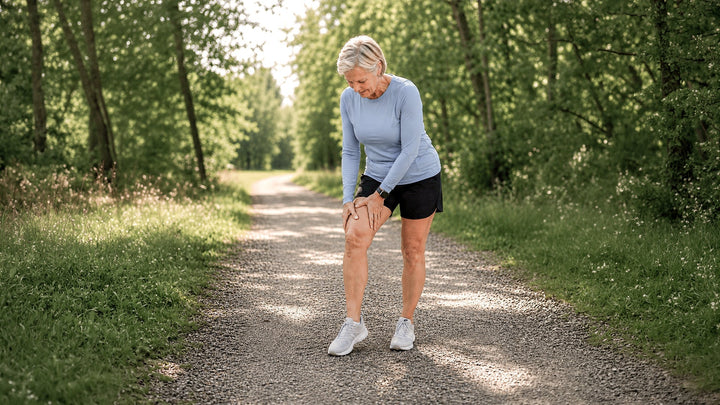
 Running places a lot of strain on the knees, and it’s common for both beginners and experienced runners to experience pain, instability or irritation in the knee at some point. A knee brace cannot treat the underlying cause of the problem, but it can provide support, relief and increased confidence while running. In this article, we explain when a knee brace may be helpful and recommend different models for common running-related knee problems.
In our Knee Injury Guide, you can read more about different knee injuries and conditions, symptoms and what you can do yourself to relieve discomfort.
When can a knee brace help with running?
Knee pain during running is common and can be caused by many different factors – for example overuse, previous injuries, instability or irritation around the kneecap. A knee brace does not treat the underlying cause itself, but it can provide support, relief and increased control during activity.
Many runners use knee braces to:
- Feel increased stability in the knee joint
- Reduce discomfort during runs
- Provide compression and support for tired or swollen knees
- Feel more confident when returning after injury
- Relieve specific structures around the knee
It is important to choose a brace that suits your needs and activity level. A brace that is too stabilising may feel bulky when running, while a brace that is too soft may not provide enough support.
The physiotherapist recommends: five knee braces for running
Here, our physiotherapist recommends five knee braces that may help with different knee problems and are suitable for running.
- Our Dynamics Plus knee brace is a thin and flexible knee brace that provides compression and light support for the knee. The plus pad around the kneecap relieves pressure on the kneecap and provides light stabilisation for an unstable kneecap. The design of the pad may also help stimulate activation of the muscles that stabilise the knee. The knee brace has a zone with extra soft fabric in the knee crease to reduce the risk of chafing in this area. Dynamics Plus is a suitable brace for mild osteoarthritis, meniscus problems or mild instability.
- The GenuFIT knee brace is a more stable model with lateral stabilising hinges. The knee brace is made from a thin and breathable material and features a polycentric hinge that closely follows the movements of the knee joint. It is a suitable model for sports and exercise when additional support and relief are needed, for example in cases of meniscus or ligament injuries.
- The ITB knee strap is specially designed to provide relief for runner’s knee without restricting knee movement. The strap is placed on the outside of the thigh just above the knee over the iliotibial band (ITB) to relieve the overloaded tendon attachment.
- The BOA knee strap is a flexible specially adapted support for jumper’s knee and patellofemoral pain syndrome (PFSS). The strap is placed below the kneecap and features a pad, a type of cushion, that applies pressure over the patellar tendon to relieve the overloaded tendon attachment at the lower edge of the kneecap (for jumper’s knee) or the joint surface behind the kneecap (for PFSS). The level of compression and relief can easily be adjusted using the BOA dial.
- The PP3 knee brace is one of our most stable knee braces and a suitable model for cruciate ligament or ligament injuries and a greater need for support. The knee brace consists of a metal frame and six non-elastic hook-and-loop straps that stabilise the knee from four points. The brace weighs only 430 grams and features a polycentric hinge that closely follows the movements of the knee joint. This makes it suitable for sports activities such as running.
Getting started with running – tips for beginners
Starting to run does not have to be complicated. The most important thing is to start slowly and give your body time to adapt to the load.
Start slowly
Many beginners run too far or too fast right away. A better approach is to alternate walking and jogging during the first weeks.
Example:
- 1 minute jogging
- 2 minutes walking
- Repeat 6–10 time
Increase gradually
Try not to increase both speed and distance at the same time. The body needs time for recovery and adaptation.
Choose good shoes
Running shoes with the right fit and cushioning can make a big difference to comfort. The shoes should feel stable and comfortable from the start.
Rest is part of training
Recovery is important, especially in the beginning. Muscles, tendons and joints need time to adapt to the new load.
Listen to your body
Temporary muscle soreness is normal, but pain that worsens or persists should be taken seriously. In that case, it may be wise to reduce the load and review your technique, shoes or training volume.
Three simple strength exercises for runners
Strength training is a good complement to running and can contribute to better running economy, increased stability and a reduced risk of overuse injuries in the knees, hips and lower legs. For most people, 1–2 strength sessions per week are enough to complement running training. The focus should be on consistency rather than intense sessions.
- Squats – Squats strengthen the thighs, glutes and core muscles – muscles that are important for stability and control while running.
How to do it:
- Stand with your feet about shoulder-width apart
- Bend your hips and knees as if sitting down on a chair
- Keep your back straight and your knees aligned with your feet
- Push yourself back up
Start using only body weight (without external weights) and focus on control before speed.
- Glute bridge – Glute bridges activate the glute muscles, which help relieve the knees and improve running form.
How to do it:
- Lie on your back with your knees bent and feet on the floor
- Tighten your glutes and lift your hips upward
- Hold for a few seconds at the top
- Slowly lower back down
Try to keep the pelvis stable throughout the movement.
- Calf raises – Strong calves help the body tolerate the impact of running and may reduce the risk of problems in the Achilles tendon and lower legs.
How to do it:
- Stand with your feet hip-width apart
- Rise up onto your toes
- Slowly lower back down
To make the exercise harder, perform it one leg at a time.
Need help choosing a knee brace?
Which knee brace is best for you depends on your symptoms, how much support you need and the type of running you do. If you are unsure, it may be a good idea to consult a physiotherapist or read more in our Injury Guide about common knee problems and their symptoms.
With the right conditions, gradual progression and support suited to your needs, running can become both gentler and more enjoyable.